What grows beneath the stillness
Updated:
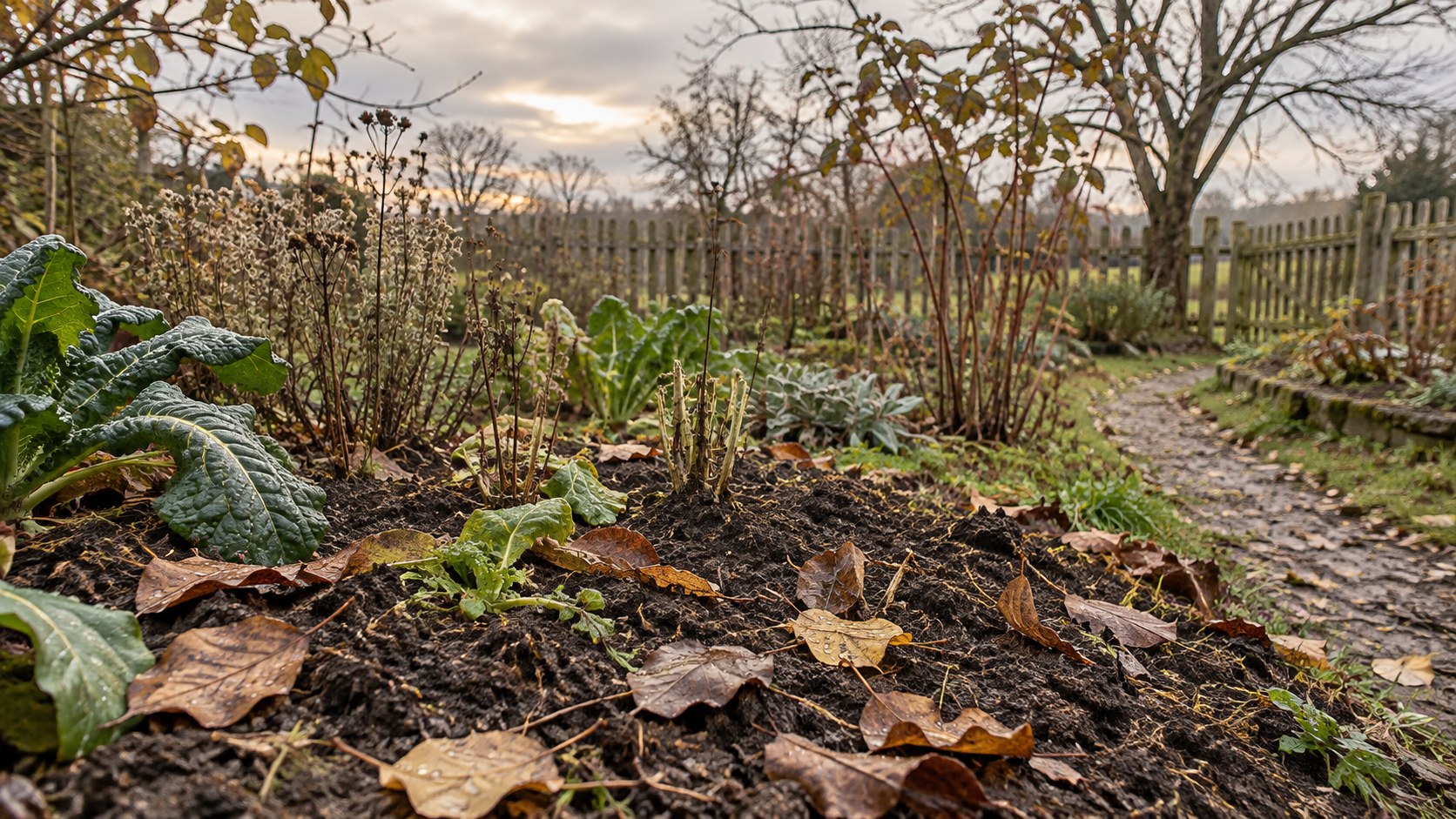
What happens beneath the quiet soil? A November reading of Rudolf Steiner.
Explore November’s soil with Steiner
What grows beneath the stillness
In November, stripped of its leaves, the garden becomes almost transparent. Where summer foliage once stopped the eye, we can suddenly see through. The fence behind the raspberries reappears. Among the perennials, patches emerge that spent months in shade. Everything seems familiar, yet we are seeing the garden from another angle.
Damp earth clings to our shoes. Leaves lie across the beds, some still yellow, others already dark and soft. Our hands find less to harvest. Our gaze lingers instead on things that barely caught our attention during the summer.
The soil, for instance. The earth from which all of this emerged.
Opening Rudolf Steiner’s Agriculture Course at this time of year brings us to a surprising thought. Just as visible growth recedes, Steiner gives particular importance to what happens below the surface. He even names the months we are entering:
“We can therefore say: around November to December there is a point when what lies beneath the earth’s surface becomes particularly effective for plant growth.”
— Lecture two, 10 June 1924, p. 50; our translation from the German
What does he mean? And how might our view of the November garden change if we follow this thought a little further?
An earth that participates in the year
Steiner develops this statement from his understanding of a connection between earth and cosmos. In his second lecture, he describes how warmth, air, water and mineral substances beneath the surface acquire, in his view, different qualities from those above it.
He understands the seasons as changes in the earth’s inner condition. He attributes to winter a particular receptivity to cosmic, form-giving forces. For mineral substances, he places a peak in this supposed “crystallising force” between mid-January and mid-February. The preceding period, explicitly November and December, matters in his account as preparation for this concentration and formation.
November is therefore part of a longer movement. For Steiner, the growth to come is already connected to processes that precede visible shoots by a considerable time. At the end of the same passage, he draws the thought together:
“We must be quite clear that the agricultural area, together with what lies beneath the soil, constitutes an individuality that continues to live through time […]”
— Lecture two, p. 50; our translation
It is worth pausing over “an individuality that continues to live through time”. Seen this way, a garden or farm has a history. Its successive states belong together: the harvested November bed, the winter earth, the first plants in spring.
For a reader today, this opens a question. How far ahead do we look when we care for a garden? To the next harvest? To next spring? Or do we learn to notice it across several years?
Steiner’s explanation of these connections is anthroposophical. His statements about cosmic forces are not descriptions of measurable soil processes. He does, however, present them as real processes with practical effects. Taking his text seriously means keeping that claim visible, even when we do not accept it.
The “head” lies beneath the earth
Another image from the same lecture shows how far Steiner takes the idea:
“The soil is a real organ; it is an organ that we might, if we wish, compare with the human diaphragm.”
— Lecture two, p. 44; our translation
Steiner imagines the soil surface as a boundary within a living whole. In his comparison, the “head” lies beneath it, while the regions corresponding to the abdomen lie above. Plants grow into this upper region; people and animals move within it.
At first, this sounds unfamiliar. We are used to seeing flowers above and roots below. Our attention follows growth upwards, towards colour, fruit and harvest. Steiner turns that familiar order upside down. In his analogy, what is hidden below the earth has an organising role within the whole.
He describes the comparison himself as an illustration that is “not entirely exact”. Nevertheless, it supports his next argument:
“There is a continuous, thoroughly living interaction between what is above the earth and what is below it […]”
— Lecture two, p. 45; our translation
In November, it is easier to linger with this connection. Summer’s abundance no longer claims our attention. Between the remaining stems, we can see where plants emerged from the soil. We remember their growth while standing before the part of their surroundings that remained hidden throughout.
Steiner’s image also questions a habit of seeing. We pay particular attention to what shows itself. How much importance do we give to what we recognise only through its effects?
Where does a plant end?
In lecture four, Steiner returns to the relationship between plant and earth. This time he asks about the boundary of living things:
“Life itself continues, particularly from the roots of the plant, into the soil, and for many plants there is no sharp boundary between life within the plant and life in the surroundings in which it lives.”
— Lecture four, 12 June 1924, p. 91; our translation
This goes further than saying that a plant needs good soil. Steiner doubts that we can understand its life adequately by looking only at its visible form. For him, the boundary drawn by the eye is not also the boundary of its living relationships.
That has consequences for his understanding of fertilisation. A few lines later he writes:
“We must understand that fertilising must consist in bringing the earth to life […]”
— Lecture four, p. 91; our translation
By bringing the earth to life, Steiner means processes he explains later in the lecture through etheric and astral forces. These terms belong to his spiritual understanding of nature. They cannot simply be replaced with present-day terms such as soil organisms or nutrient cycling.
Yet the question he directs towards cultivation remains understandable. What condition should the earth be in when a plant grows into it? Our attention moves from the individual plant to the place in which it lives.
Standing before a harvested bed gives that question a particular resonance. The plants we tended for months have largely disappeared. Their place remains. How do we treat it now?
A personal relationship with the earth
Here Steiner becomes strikingly direct. He asks those who work in agriculture
“[…] to develop a kind of personal relationship with everything that matters in agriculture, above all a personal relationship with manure and, particularly, with working with manure.”
— Lecture four, p. 91; our translation
A personal relationship with manure: it is an awkward, almost uncomfortable phrase. It takes us straight into the gardening work that rarely appears in beautiful pictures.
Steiner stays with it. On the following pages he speaks about smells, about inside and outside, about forces being retained or escaping. These explanations, too, belong to his anthroposophical understanding of life. His call for a personal relationship is closely connected here to perceiving the material through the senses.
For the November garden, we can draw from this a concrete way of paying attention. Eventually, we know the smell of our compost. We notice whether leaves lie loosely or have collapsed into a wet layer. We remember where water lingered last winter.
This familiarity grows through repeated observation and work. We come to know a garden much as we know a place we return to over the years: only gradually do the differences become apparent.
Compost also has a particular place in Steiner’s account. He calls it a means of bringing the earth to life and specifically lists the often disregarded remains from farming and gardening, including fallen leaves (p. 94).
This belongs naturally in November without turning it into a November instruction written by Steiner. Material that has left its former place now lies everywhere. We decide what happens to it. In that everyday work, we reveal how we understand the end of a growing season and what we carry forward from it.
What Steiner means by winter’s inner life
Against this background, we can read more closely the sentence often quoted on its own:
“The earth is most inwardly alive in winter.”
— Lecture four, p. 100; our translation
It appears in his account of preparing horn manure. Steiner explains why cow horns filled with manure should remain buried through winter. He attributes to the horn an ability to reflect etheric and astral forces inwards. In his account, winter soil provides the surroundings in which these forces concentrate within the contents.
The sentence thus forms part of a particular explanation for a particular practice. Using it merely as an attractive description of winter quiet would obscure its actual context. Nor does it describe especially high activity among soil organisms in winter.
What may hold our attention is its reversal of familiar perception. A bare landscape first appears to us as a retreat of life. In Steiner’s interpretation, this very season carries a particular inner effectiveness. For his agriculture, the timing of an activity therefore belongs to its nature: winter and summer are conditions with different effects.
For our own garden, this raises a further question. Do we give every season enough attention? Do we know our garden even when it offers us no harvest?
Through November with the garden
After reading, perhaps we go outside a little differently. The same bed is still before us. A few leaves have gathered around the remaining stems. The soil is darker at the edge than in the middle. Something rustles behind the hedge.
We need not look for confirmation of Steiner’s cosmic ideas here. We can examine his thinking while allowing his questions to broaden our attention: to soil as a living environment, to the connection between plant and surroundings, to the consequences of our work beyond a single season.
At PermaNatura, this connects with the idea of continuity through becoming. The garden we wish to sustain is constantly changing. Leaves detach from branches, harvest remains move elsewhere, beds become empty. Our care accompanies these transitions.
November gives us more room for this than the busy harvest season. As we gather leaves, perhaps we remember spring: what we intended, what grew well, and the places we still do not quite understand.
Such experiences make a garden familiar to us. Its bare months belong to that familiarity too. And when we finally lean the rake against the shed wall, we leave behind a place whose story continues.
Sources and editorial context
Rudolf Steiner, Geisteswissenschaftliche Grundlagen zum Gedeihen der Landwirtschaft (Landwirtschaftlicher Kurs), GA 327. Lecture two, Koberwitz, 10 June 1924, especially pp. 43–50; lecture four, 12 June 1924, especially pp. 91–100. All quotations are PermaNatura’s editorial translations of the German PDF used for this article, not quotations from a published English edition. Page numbers refer to the printed German book. Line breaks and split words have been joined; omissions are marked […]. Connections to present-day gardening and PermaNatura are editorial interpretations. The seasonal setting is Central Europe.
The cover image was generated with AI for this article. It illustrates a November garden and does not document an experiment or a biodynamic farm.