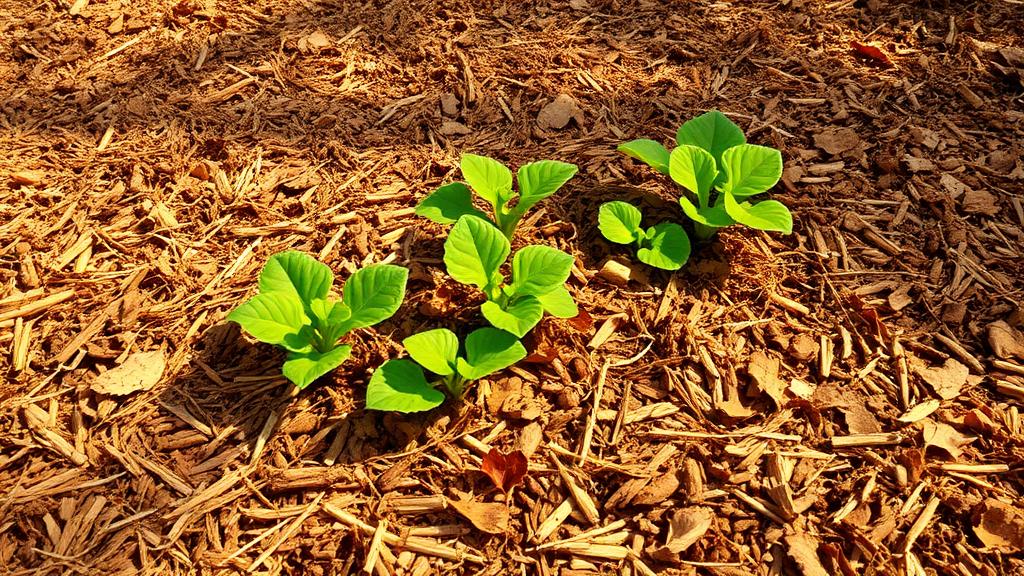
Mulching in the Garden: Less Watering, Less Weeding, More Harvest
Mulching in the Garden – Less Watering, Less Weeding, More Harvest
Mulching is one of the simplest and most effective practices in organic gardening. With a 5–10 cm thick layer of mulch, you save up to 50% water, 80% of weeding work, and feed your soil life at the same time.
In nature, there is no bare soil – mulching mimics this state.
What Mulching Really Does
| Effect | Impact | Measurable |
|---|---|---|
| Evaporation protection | Soil stays moist | up to 50% less water |
| Temperature buffer | cool in summer, frost protection in winter | up to 8 °C difference |
| Weed suppression | less light reaching the soil | approx. 80% fewer weeds |
| Soil life | earthworms + microbes active | up to 4× more earthworms |
| Erosion protection | soil is not washed away | heavy-rain tolerant |
| Humus build-up | mulch decomposes into humus | +0.1–0.3% humus/year |
Which Mulch Material for What?
| Material | Suitable for | Thickness | Pros/Cons |
|---|---|---|---|
| Grass clippings | vegetable beds, tomatoes | 3–5 cm, let dry out | ✅ free, nitrogen-rich · ❌ molds when fresh |
| Straw | strawberries, tomatoes, potatoes | 8–10 cm | ✅ dry, durable · ❌ binds nitrogen when worked in |
| Hay | vegetable beds | 5–8 cm | ✅ nutrient-rich · ❌ may contain seeds |
| Leaves | beds in winter, shrubs | 10–15 cm | ✅ free, for hedgehogs/insects · ❌ oak/walnut acidic/inhibiting |
| Wood chips | paths, shrubs, berry bushes | 5–10 cm | ✅ durable 2–3 yrs · ❌ depletes N → unsuitable for vegetables |
| Bark mulch | ornamental beds, hedges | 5–8 cm | ✅ attractive · ❌ acidifies, tannic acid |
| Sheep's wool | tomatoes, heavy feeders | 1–3 cm | ✅ fertilizing effect for 6 months · ❌ expensive |
| Compost | vegetable beds | 2–3 cm | ✅ fertilization + mulch · ❌ weed seeds possible |
| Living mulch (clover, phacelia) | orchard, vegetables | permanent | ✅ active N-fixation · ❌ competition for light feeders |
💡 Rule of thumb: Nitrogen-rich (grass, clover, sheep's wool) → for heavy feeders (tomato, cabbage). Nitrogen-poor (straw, wood) → for light feeders and paths.
Step-by-Step: How to Mulch Correctly
- Prepare the soil – weed the bed, hoe lightly, water well
- Nitrogen boost for carbon-rich material (straw, wood) – horn shavings or nettle slurry
- Apply mulch – 5–10 cm thick, NOT right up to the stem (risk of rot)
- Leave 2–3 cm of distance from the plant stem
- In spring, pull the mulch layer aside so the soil can warm up
- In autumn, a thick mulch cover (10–15 cm of leaves/straw) as a winter blanket
Mulching by Season
| Time | Action | Material |
|---|---|---|
| March/April | pull back mulch, let soil warm up | – |
| May | mulch thinly after planting | grass clippings 3 cm |
| June–August | build up thickly, evaporation protection | straw/hay 8 cm |
| September | clear beds, sow green manure | phacelia, mustard |
| November–February | winter blanket | leaves + straw 10 cm |
Common Mulching Mistakes
| Mistake | Consequence | Solution |
|---|---|---|
| Mulch up to the stem | rot, slugs | leave 3 cm distance |
| Fresh grass clippings thick | rot, odor | let dry out, max. 3 cm |
| Wood chips in vegetable bed | nitrogen lock | only on paths/shrubs |
| Leaving mulch in spring | soil stays too cold | pull back in March |
| Walnut leaves in the bed | juglone inhibits growth | compost only on paths |
The Slug Myth
Prejudice: "Mulch attracts slugs." Only partly true. Fresh, moist grass clippings yes – dry straw, wood chips and sheep's wool actually act as a deterrent, because slugs cannot move across them.
💡 Tip: When slug pressure is high: apply mulch in the morning so the surface dries out during the day.
Mulch + Green Manure = Top Soil
The most effective soil care combines both methods:
- Sow green manure (phacelia, clover, buckwheat) in late summer
- Mow before frost and leave it lying → living mulch
- In spring, work it lightly into the soil (max. 5 cm deep)
This creates a living mulch layer with a fertilizing effect over winter.
Saving Water: Concrete Figures
During dry spells, an unmulched bed evaporates approx. 4–6 liters per m² per day. With 8 cm of straw mulch, this drops to 1.5–2.5 L/m²/day. For a 20 m² vegetable bed, that means 70 liters of water savings per day – over the season, several thousand liters.
Conclusion
Mulching is the simplest, cheapest and most effective soil care. Those who mulch consistently water less often, weed less and harvest more. You don't need any money for it, just material from your own garden.
💡 PermaNatura practical tip: Activate the "Mulch" reminder in the bed planner for May and September – with suggestions for suitable materials depending on your planting. The water consumption widget shows you the effect directly in the efficiency score.
Sources: FiBL (Research Institute of Organic Agriculture), Bavarian State Research Center for Agriculture, Demeter horticulture field studies.
Comments (0)
Sign in to comment.