Using Rainwater in the Garden: From the Barrel to the Smart Cistern
Summer is blazing down from the sky, the soil of your vegetable bed is cracked, and the weather app promises no relief for the coming week either. You reach for the garden hose, but as you turn the tap you inevitably think of two things: the rising water bill and the precious resource of drinking water that you are spraying onto your lawn right now. We all know this scenario, and in the future it will be the rule rather than the exception. The good news is: the solution literally falls from the sky.
Rainwater harvesting is far more than just an ecological gimmick for a handful of enthusiasts. It is an intelligent, economically sensible and future-proof strategy for every gardener. It is about capturing a free, high-quality resource and deploying it precisely when we need it most. Whether you tend a small city balcony, an allotment garden or a large self-sufficiency garden - collecting rainwater is a decisive step towards greater independence and resilience.
In this article we dive deep into the subject. We clarify why rainwater is the best irrigation water, how to calculate your potential yield, which systems are available and how to find the solution that suits you. Consider this your comprehensive guide to getting the maximum out of every rain shower for your garden.
Why Rainwater Is the New Gold for Your Garden
The decision to collect rainwater rests on four strong pillars: cost savings, plant health, climate adaptation and environmental protection. Each one on its own is already a good argument, but taken together they make rainwater use almost without alternative.
Save Money and Conserve Drinking Water
The most obvious advantage is the direct financial saving. Drinking water is treated at great expense and is subject to the strictest controls. This process and the maintenance of the infrastructure cost money, which is reflected in the water and wastewater charges. In many municipalities of the DACH region you pay not only for the fresh water you draw, but also for the wastewater that you supposedly produce - often charged at a flat rate. Every litre of rainwater you use is a litre of expensive tap water that you do not have to pay for. For an average garden, this can quickly add up to triple-digit amounts over the year.
Balm for Your Plants: Soft, Lime-Free Water
Have you ever wondered why plants often look more vigorous after a rain shower than after watering with the garden hose? The answer lies in the water quality. Depending on the region, tap water is often hard, meaning rich in calcium and magnesium carbonate (lime). Many plants, especially bog-bed plants such as rhododendrons, azaleas and blueberries, but also tomatoes and cucumbers, prefer slightly acidic soil conditions. Lime-rich water raises the pH value of the soil and can, over time, block the plants' nutrient uptake. Rainwater, on the other hand, is naturally soft, lime-free and has a slightly acidic pH value (mostly between 5.5 and 6.5) - ideal for most garden plants. It also contains no added chlorine, which some waterworks use for disinfection.
Outsmarting Climate Change
The effects of climate change are unmistakable: longer and more intense dry spells in summer alternate with sudden heavy rainfall events. Your own water reservoir makes you more independent of these extremes. While your neighbours may be confronted with watering bans imposed by the municipality or have to let their lawns turn yellow, you can save your harvest with the water collected during the last rainy spell. Rainwater use is therefore an active strategy for adapting to a changing climate and secures the supply of your garden in critical phases.
Relieve the Sewer System and Prevent Flooding
During heavy rainfall, public sewer systems can quickly reach their limits. Large quantities of water running off sealed surfaces such as roofs, terraces and paths lead to overloading and, in the worst case, to local flooding. Every litre of water you retain in a cistern or rain barrel relieves the system. Many municipalities have recognised this and levy a so-called "split wastewater charge" or "stormwater charge" for sealed surfaces connected to the sewer system. If you use your rainwater and allow the overflow to seep away on your own property (more on this later), you can often reduce or even completely avoid these charges. (You can obtain information about this from your city or municipal administration.)
How Much Water Can You Harvest? A Simple Calculation
Before you invest in a system, you should estimate how much water you can actually collect. This helps you to size your reservoir realistically. The calculation is surprisingly simple and follows a clear formula:
Annual rainwater yield (litres) = Annual precipitation (mm/m2) x Roof base area (m2) x Runoff coefficient
Let us look at the components in more detail:
- Annual precipitation: This value indicates how many litres of rain fall per square metre in your region on an annual average. It varies greatly, from approx. 500-600 mm in dry regions (e.g. Brandenburg) to over 1,500 mm in alpine locations. You can find precise data for your location on the websites of the national weather services (e.g. Deutscher Wetterdienst (DWD), GeoSphere Austria, MeteoSchweiz).
- Roof base area: What matters here is not the sloping roof surface, but the projected base area, i.e. the length times the width of the house or garage whose roof you wish to use.
- Runoff coefficient: Not all the water that falls on your roof ends up in the reservoir. Part of it evaporates or clings to surfaces. This factor accounts for that. For a classic tiled roof, a value of 0.75 to 0.9 is realistic. A good average for planning is 0.8. For green roofs the value is considerably lower (approx. 0.3-0.5), and for smooth metal roofs somewhat higher.
Sample calculation: You live in a region with 800 mm of annual precipitation and would like to use the roof of your garage with a base area of 6 m x 4 m = 24 m2. Yield = 800 l/m2 x 24 m2 x 0.8 = 15,360 litres per year That is over 15 cubic metres of water - a considerable amount from such a small surface!
Determining the Demand: How Thirsty Is Your Garden?
The potential yield is one side, the actual demand the other. How much water your garden needs depends on the planting, the soil, the local climate and your watering method. Sandy soils need to be watered more frequently, loamy soils less often but more deeply. A vegetable bed has a higher water requirement than an established perennial bed with drought-tolerant plants.
The following table gives you rough guideline values that will help you better estimate your storage needs. The values refer to the main growing season from May to September.
| Garden Type | Water Requirement per Season (approx.) | Example for 100 m2 Area |
|---|---|---|
| Lawn area | 200 - 400 litres / m2 | 20,000 - 40,000 litres (20-40 m3) |
| Vegetable bed (heavy feeders) | 300 - 600 litres / m2 | 30,000 - 60,000 litres (30-60 m3) |
| Perennial bed (mixed) | 150 - 300 litres / m2 | 15,000 - 30,000 litres (15-30 m3) |
| Fruit trees (young planting) | 100 - 200 litres / m2 | 10,000 - 20,000 litres (10-20 m3) |
These figures quickly make one thing clear: to keep an entire garden self-sufficient through a dry summer, very large reservoirs are needed. But do not let that discourage you! Every rain barrel is a start and helps to cover the peaks in water demand.
Spoilt for Choice: Which System Suits You?
From the simple barrel to the fully automatic underground cistern - the range of systems is large. The choice depends on your budget, the available space and your water requirement.
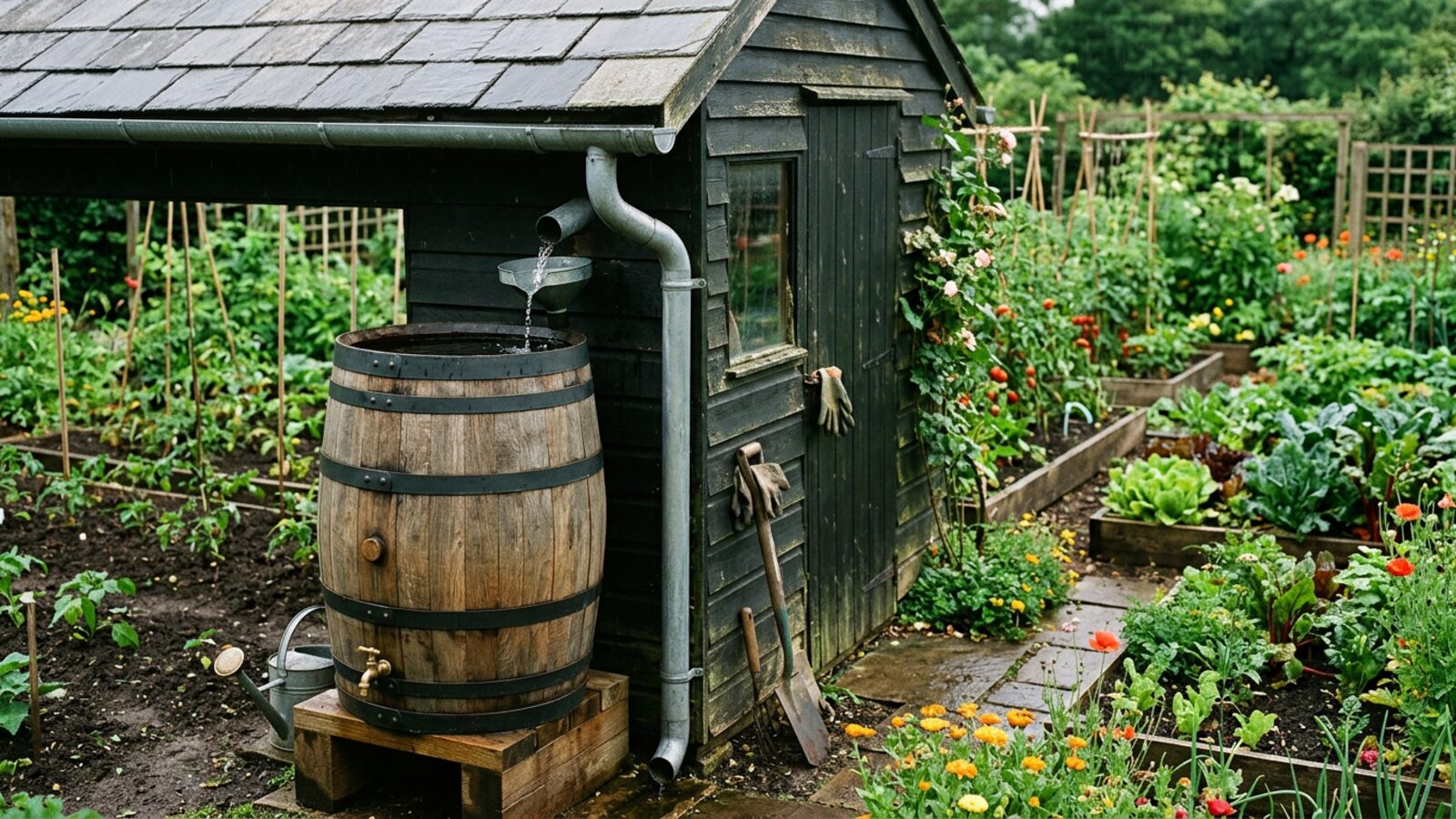
The Classic: The Rain Barrel (200 - 500 Litres)
The simple rain barrel is the perfect entry point. It is inexpensive, quickly installed (just mount a rainwater diverter on the downpipe) and ideal for small gardens, greenhouses or balconies. The water is usually drawn off with a watering can.
- Advantages: Low cost, easy installation, flexible placement.
- Disadvantages: Small volume (quickly full after heavy rain, quickly empty in a dry spell), algae formation when exposed to light, mosquito breeding ground without a lid.
The All-Rounder: The Above-Ground Tank (1,000 - 2,000 Litres)
These tanks, often available as square "IBC containers" or in a decorative stone or wood look, already offer a considerable volume. They hold 1-2 cubic metres (1,000-2,000 litres) and can often be connected to one another to increase capacity. They are usually equipped with an outlet tap to which a hose can also be connected.
- Advantages: Good value for money, considerably more volume than a barrel, relatively simple to set up.
- Disadvantages: Requires a visible standing area in the garden, not frost-proof (must be emptied in winter).
The Professional Solution: The Underground Cistern (3,000 - 10,000+ Litres)
For large gardens, high self-sufficiency ambitions and an invisible solution, the underground cistern is the first choice. The water is stored cool, dark and algae-free in the ground. With a connected pump it can be conveniently used for garden irrigation or even for toilet flushing and the washing machine in the house (so-called service water use).
Material: Plastic vs. Concrete
- Plastic cisterns (PE): They are lightweight, which makes transport and installation (often as a DIY project) easier. They are available in many shapes and sizes.
- Concrete cisterns (usually rings or monoliths): They are extremely robust and durable. Their high weight provides buoyancy protection when the groundwater level is high. The concrete can also somewhat neutralise the slightly acidic rainwater. Installation requires heavy equipment.
Permit?
The installation of a cistern is generally not subject to a permit requirement, as long as it is only used for garden irrigation. However, an obligation to notify the municipality may exist, especially if you want to allow the overflow to seep away on the property. If you plan to use it inside the house (service water), you must report this to the water supplier without fail and ensure separate pipework in order to rule out any contamination of the drinking water network. (When in doubt, always ask your local building authority! The regulations vary by federal state and municipality.)
The Heart of the Matter: Components for a Functioning System
A rainwater system is more than just a tank. Only the right components turn it into an efficient and low-maintenance installation.
- The Guardian at the Gate: Filters: A good filter is the be-all and end-all. It keeps leaves, moss and other dirt out of the reservoir and thus safeguards the water quality. Simple solutions are leaf screens for the gutter or rainwater diverters with an integrated filter. With cisterns, more powerful vortex fine filters or basket filters in the manhole shaft are often used.
- Safety First: The Overflow: What happens when the reservoir is full? The overflow channels excess water away in a controlled manner. Ideally it leads into a soakaway system (e.g. a soakaway trench or a seepage shaft) on your own property. This recharges the groundwater and relieves the sewer system. Only if seepage is not possible should the connection to the stormwater sewer be made.
- The Lifeline: Intake and Pump Technology: To get the water out of the reservoir, you need a pump. For cisterns, a submersible pressure pump has proven effective; it hangs directly in the water and delivers it with sufficient pressure for lawn sprinklers or a long hose. These often have an integrated automatic switch that starts the pump when the tap is opened. A floating intake draws the water from just below the surface, where it is cleanest.
- Distribute Efficiently: From the Watering Can to Drip Irrigation: If you are already collecting valuable rainwater, you should also use it efficiently. Instead of watering large areas with the sprinkler, targeted methods such as drip irrigation or soaker hoses are ideal. They bring the water directly to the roots, minimise evaporation and save up to 70 % of water.
Care and Maintenance: How to Keep Your System Fit
A well-planned rainwater system is very low-maintenance. With a few regular routines you ensure a long service life and good water quality.
- Check the filters (several times a year): Depending on the amount of leaves, you should check and clean the filters, especially after the autumn leaf fall and the spring blossom.
- Clean the tank/cistern (every 5-10 years): Over time, a thin layer of sediment forms at the bottom. This is usually unproblematic, but should be removed when necessary (approx. every 5-10 years for cisterns).
- Check the pump (annually): Briefly check the function before the gardening season.
- Winterproofing: Above-ground barrels and tanks must be emptied before the first frost in order to avoid frost damage. Above-ground pumps and hoses must also be drained and stored frost-free. Submersible pumps in a cistern lying frost-proof in the ground can remain there.
Strategies for the Dry Season
Even the largest cistern can be empty after weeks of drought. That is when clever water management is called for.
- Mulch, mulch, mulch: A thick layer of mulch (e.g. grass clippings, straw, wood chips) on the beds is the most effective measure for reducing evaporation and keeping the soil moist.
- Water in the morning: Water in the early morning hours. Then the soil is cool and the water can penetrate deeply instead of evaporating in the midday heat.
- Water in a targeted and penetrating way: Water less often, but vigorously and directly in the root zone. This encourages the plants to form deeper roots, which makes them more resilient.
- Set priorities: When water becomes scarce, concentrate on the most important crops. The vegetable bed and young plantings take precedence over the lawn.
Using rainwater is an investment in the future of your garden and an active contribution to environmental protection. It requires an initial amount of planning and investment, but it quickly pays off through cost savings, healthier plants and greater independence from the weather. Perhaps start with a simple rain barrel and observe how much water you can collect. You will be amazed at the potential that lies dormant even in the smallest space.
To avoid losing track of your garden's water requirements and your watering intervals, digital garden planners can be a great help. Good documentation, such as that made possible by PermaNatura, helps you to deploy your valuable rainwater exactly when and where it is needed most, and to optimise your measures in the long term. So, what are you waiting for? The next rain is sure to come.
Comments (0)
Sign in to comment.
📖 You might also like
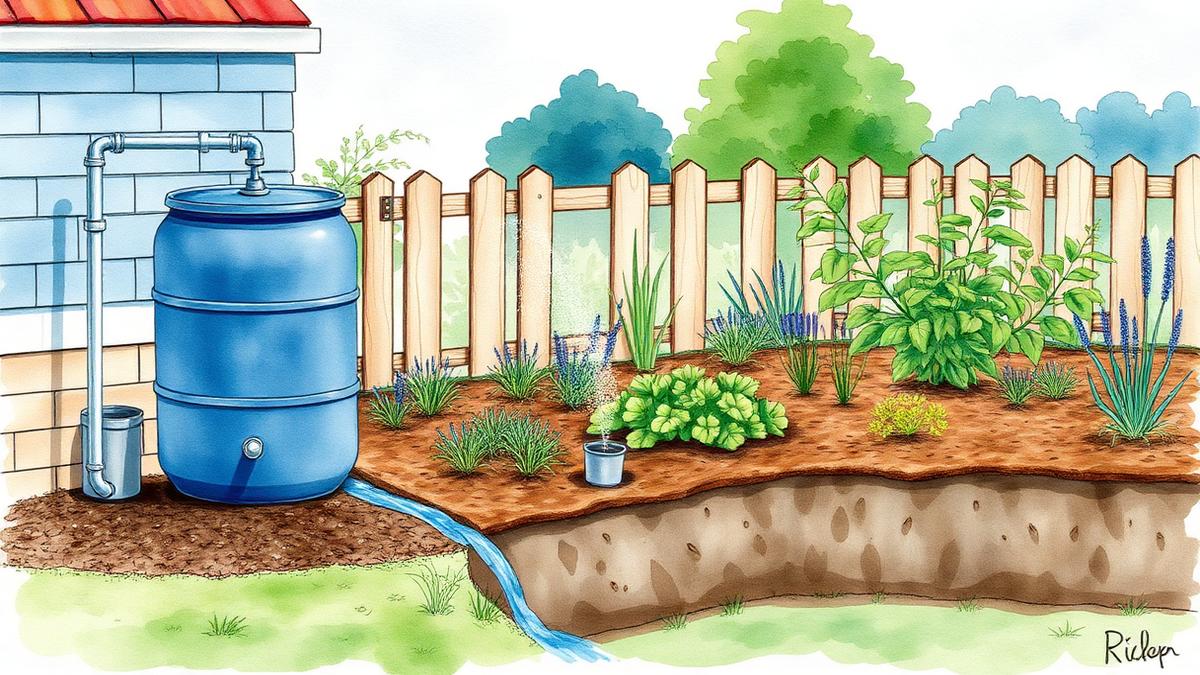
Water Management in a Changing Climate: How to Make Your Garden Drought-Resistant
Heat records and drought periods are presenting gardeners with new challenges. Learn strategies for efficient water management – from rainwater harvesting to drip irrigation.
Read more
Which app to plan a vegetable garden? The honest 2026 comparison
You want to plan your vegetable beds digitally but aren't sure which app is right? This comparison shows what really matters – from companion planting and the sowing calendar to data privacy – and which type of gardener each solution suits.
Read more
Ozone Stress in the Garden 2026: The Invisible Heat Damage on Tomatoes, Beans and Leafy Greens
When heat, strong sun and stagnant air come together, ground-level ozone can damage plant cells. Learn how to recognise ozone stress, separate it from drought, and protect your beds.
Read more