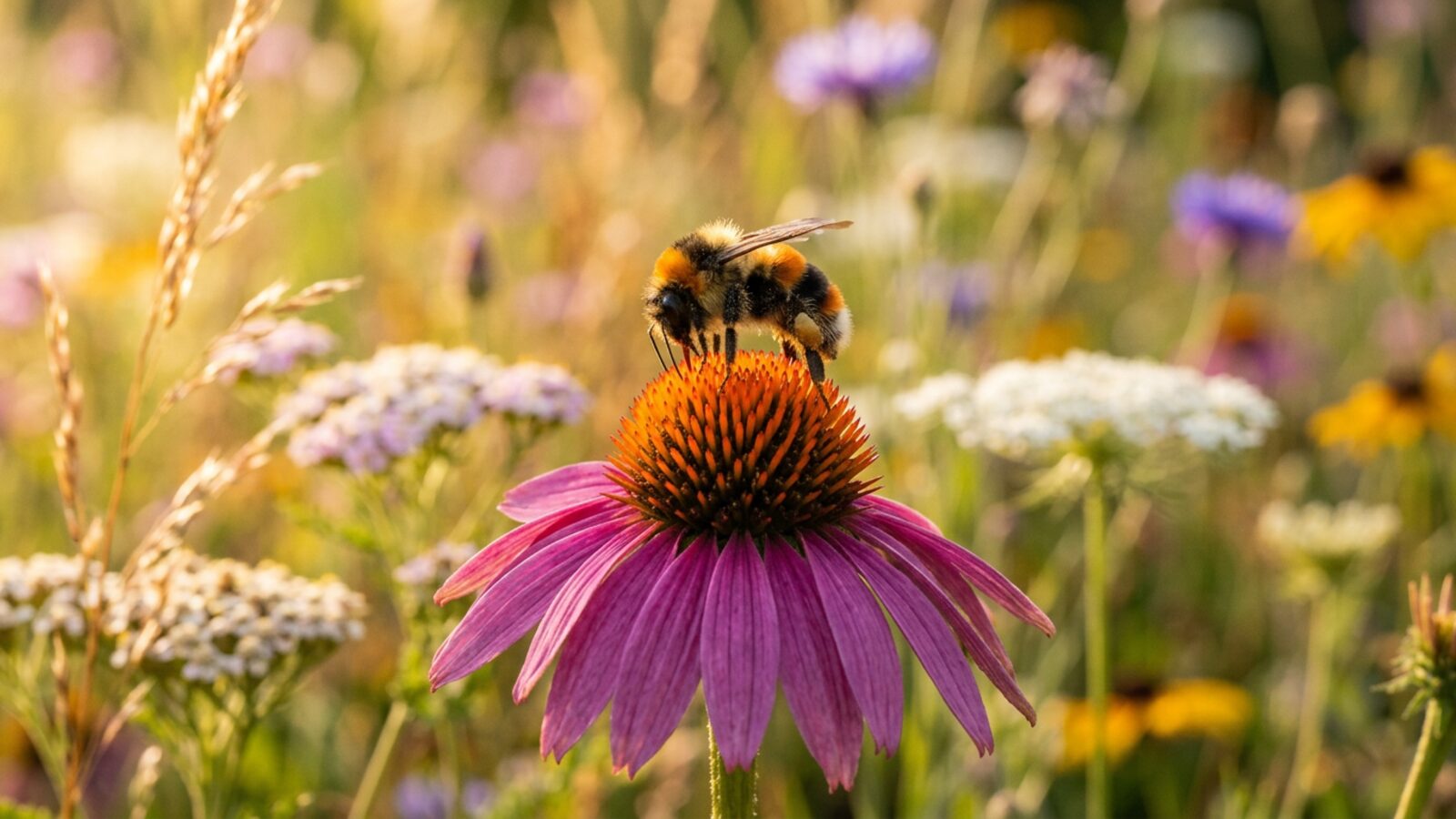
Creating a Wild Bee Garden: 7 Steps to a Pollinator Paradise
For many of us, the buzzing in the garden is as much a part of summer as the scent of freshly mown grass. But have you listened more closely lately? The buzzing has grown quieter. It is a gradual process that often escapes our direct perception, but the scientific data speaks a clear language: we are witnessing a dramatic decline in insect diversity, and wild bees are especially affected. They are the unsung heroines of our ecosystems, tirelessly pollinating flowers and thereby ensuring the diversity of our plant world and a large share of our food.
Many people immediately think of the honey bee in its hive when they hear "bees". But the real diversity takes place out of sight. In Germany alone there are around 560 different wild bee species - from the tiny yellow-faced bee, only a few millimetres in size, to the impressive, blue-black shimmering carpenter bee. There are bumblebees, mining bees, mason bees and many more. Their ways of life are fascinating and highly specialised. But this natural heritage is in danger. More than half of these species are now on the Red List of endangered animals. The loss of their habitats, the lack of food sources and the use of pesticides are taking a massive toll on them.
The good news is: every one of us with a garden, a balcony, or even just a windowsill can make an important contribution to reversing this trend. It is not about creating the perfect, fully styled eco-garden. Rather, it is about understanding the needs of these fascinating insects and lending them a hand - or rather, a wing - with targeted and often surprisingly simple measures. This article is your comprehensive guide to transforming your outdoor space into a blooming paradise for wild bees - scientifically grounded and proven in practice.
The Silent Disappearance: Why Wild Bees Need Our Help
Before we dive into the practical side, a brief look at the "why" is crucial. Unlike the honey bee, which is a colony-forming domestic animal cared for and tended by the beekeeper, wild bees are mostly solitary. Each female builds her own nest, collects pollen and nectar, and provides for the offspring on her own. They are often specialised on particular plant families ("oligolectic") and sometimes fly only a few hundred metres from their nest. If their food plant or nesting site disappears, they disappear too.
Their pollination performance is enormous and often more efficient than that of honey bees. Many plants, such as tomatoes or blueberries, depend on so-called buzz pollination, which can only be carried out by bumblebees and a few other wild bee species. Without them there would be far fewer fruits and seeds. Protecting wild bees is therefore not an end in itself, but a direct investment in the stability of our ecosystems and the security of our harvests. Conservation organisations such as NABU or BUND have been pointing to this critical connection for years. The responsibility lies not only with agriculture, but with every individual who manages a piece of land.
Step 1: A Table Set All Year Round
The greatest challenge for wild bees is finding food throughout the entire growing season. Many gardens explode into floral splendour in May and June, but before and after that there is often a yawning emptiness. The species that hatch early in the year and the bumblebee queens still active in autumn especially depend on an uninterrupted supply. Your goal should be to provide food from the first crocus to the last ivy leaf.
Native Instead of Exotic: Quality Over Quantity
The key lies in choosing the right plants. Native wild plants are the first choice, because they and the native bee species have adapted to one another over thousands of years. Many wild bees can do nothing with the flowers of exotic ornamental plants such as forsythia or double roses. Double flowers are a breeding dead end for insects: the stamens that carry the nutritious pollen have been bred into sterile petals. They may look lush, but for bees they are a worthless decoy.
- Go for diversity: Combine different plant families to appeal to a broad spectrum of bee species.
- Prefer single (unfilled) flowers: When buying, make sure the stamens in the centre of the flower are clearly visible.
- Allow wild herbs: Dandelion, clover and dead-nettle are valuable early food sources. Let them bloom in a corner of your garden.
The following table gives you an overview of valuable nectar and pollen plants for the entire bee year:
| Month | Important nectar and pollen plants for wild bees |
|---|---|
| February - March | Winter aconite, crocus, snowdrop, goat willow, cornelian cherry |
| April - May | Fruit trees (apple, cherry), blackthorn, dandelion, lungwort, maple, currant |
| June - July | Bellflowers, meadow sage, viper's bugloss, mallows, wild teasel, knapweeds |
| July - August | Oregano (wild marjoram), thyme, lavender, chicory, sunflower (single-flowered) |
| August - September | Tansy, purple loosestrife, stonecrop (tall varieties), phacelia (bee's friend) |
| September - October | Asters (native varieties), ivy, autumn anemones, common hemp-agrimony |
Step 2: A Home for Every Bee - Creating Nesting Sites
About 75% of all native wild bee species are ground or soil nesters! This is probably the most frequently overlooked fact in wild bee conservation. Store-bought "bee hotels" serve only a small portion of the species that nest in cavities. A truly bee-friendly garden therefore offers a wide variety of structures.
For the Majority: Open Soil and Sand Patches
Most wild bees dig their nesting tunnels into the ground. They prefer sparsely vegetated, sunny and dry spots. A perfectly maintained, dense lawn or a wall-to-wall mulch layer is uninhabitable for them.
- Create open soil patches: Deliberately leave gaps in the planting on sunny banks or path edges.
- Lay out a sand patch: On a fully sunny, dry spot, dig a pit of about 50x50 cm and 40 cm deep. Fill it with unwashed sand (e.g. from a nearby sand pit, not with play sand). This allows rainwater to drain away quickly and the bees can dig their tunnels.
- Use joints: Paving joints in paths or terraces that are filled only with sand are also readily accepted as nesting sites.
For Cavity Dwellers: Pithy Stems Instead of Bamboo
The insect hotels often on offer are unfortunately frequently unsuitable or even harmful. Bamboo tubes splinter easily and can injure the bees' delicate wings. The holes are often too large, too small or not deep enough. Natural materials are better and cheaper.
- Collect hollow and pith-filled stems: The stems of blackberries, raspberries, mulleins, elder or wild roses are ideal. Cut them to about 20 cm in length and bundle them horizontally. Many bee species gnaw their own tunnel into the soft pith.
- Drill into hardwood: Take seasoned pieces of hardwood (beech, oak, ash) and drill clean holes (do not drill all the way through!) with diameters of 2 to 9 mm. The edges must be smooth so that the bees do not injure themselves. Hang these blocks in a sunny, rain-protected spot.
- Deadwood is life: An old tree stump or a pile of thick branches in a sunny spot is a paradise. Numerous bee species nest here, and a whole small ecosystem develops.
Step 3: Lean Meadow Instead of English Golf Lawn
The dense, deep-green roll-out lawn is an ecological desert. It offers neither food nor nesting sites. A flower meadow or a lean meadow, on the other hand, is the exact opposite. On nutrient-poor soils, low-competition wildflowers can establish themselves, attracting an immense diversity of insects.
- Create a lean meadow: On a selected area, remove the top 10-15 cm of nutrient-rich topsoil and impoverish the subsoil with sand.
- The right seed: Sow a mixture of native wildflowers and grasses suited to your region (certified regional seed is the best choice).
- The right care: Mow the meadow only once or twice a year (the first time after the main bloom in June/July) and remove the cuttings to further impoverish the soil.
Steps 4 & 5: Water and Going Without Poison
Insects need water too, especially on hot days. A shallow dish filled with marbles, stones or moss serves as a safe drinking spot. The water should be renewed regularly. The stones are important so that the bees have a landing place and do not drown.
The most important and at the same time simplest step is to completely forgo chemical-synthetic pesticides and herbicides. These agents not only kill the "pests", but also hit wild bees and other beneficial insects - either directly or indirectly through the uptake of contaminated pollen and nectar. Accept a few aphids (ladybird larvae will thank you for it) and remove unwanted herbs by hand. Healthy soil and a diverse plant community are the best plant protection.
Steps 6 & 7: Winter Rest and the Art of "Doing Nothing"
A tidied-up garden in autumn is a nightmare for wildlife. The larvae and pupae of the next wild bee generation overwinter in the hollow stems of perennials, in leaf piles and in deadwood.
- Leave spent growth standing: Cut perennials and grasses back only in late spring (end of February/beginning of March). The seed heads are also an important winter food for birds.
- Create "wild corners": A pile of leaves and branches in a garden corner is a valuable overwintering site for hedgehogs, beetles and indeed some bumblebee queens.
Wild Bees on the Balcony: No Garden? No Problem!
Even without a garden you can make a valuable contribution. The principles remain the same, only the scale is smaller.
- Large pots: Choose deep containers and balcony boxes and plant them with a mixture of native wild herbs and perennials. Thyme, bellflowers, lavender and stonecrop are excellent choices.
- Nesting aids in miniature: A small hardwood block with clean drilled holes or some pith-filled stems, fixed to a sunny, rain-protected wall, are readily accepted.
- A sandbox for nesting: A large, deep flower box filled with a sand-loam mixture can serve ground-nesting species as a home on the balcony.
- Don't forget a water source: A small dish with pebbles fits on even the smallest balcony.
Your Effort Counts - Every Square Metre a Habitat
Creating a garden for wild bees is not a project with a fixed end point, but a journey. It is a rethinking, away from the perfect, tidy ornamental garden towards a living, dynamic and perhaps slightly "untidy" habitat. Start small. Swap a geranium for a bellflower. Leave a corner of your lawn unmown. Stop spraying poison against the aphids on the roses. You will be surprised how quickly the first visitors arrive and your garden begins to buzz.
When you start planting native perennials, setting up nesting sites and planning bloom times, things can quickly become hard to keep track of. Maintaining an overview of all the new plants, their flowering times and the measures carried out is crucial for long-term success. A digital garden planner can be a valuable support here. A tool like PermaNatura helps you to document your sowings, plantings and care measures. This way you ensure that your wild bee paradise becomes more diverse from year to year and that you turn the quiet buzzing in your garden back into a loud hum. Start today - every square metre counts
Comments (0)
Sign in to comment.
📖 You might also like
Which app to plan a vegetable garden? The honest 2026 comparison
You want to plan your vegetable beds digitally but aren't sure which app is right? This comparison shows what really matters – from companion planting and the sowing calendar to data privacy – and which type of gardener each solution suits.
Read more
Ozone Stress in the Garden 2026: The Invisible Heat Damage on Tomatoes, Beans and Leafy Greens
When heat, strong sun and stagnant air come together, ground-level ozone can damage plant cells. Learn how to recognise ozone stress, separate it from drought, and protect your beds.
Read more
Full Moon Meets Heatwave: What Your Garden Needs on This Special Night
Tonight the Moon is almost full – and the heatwave is still here. Two forces pull at the garden. What lunar tradition says, what the heat demands, and how to bring them together wisely.
Read more