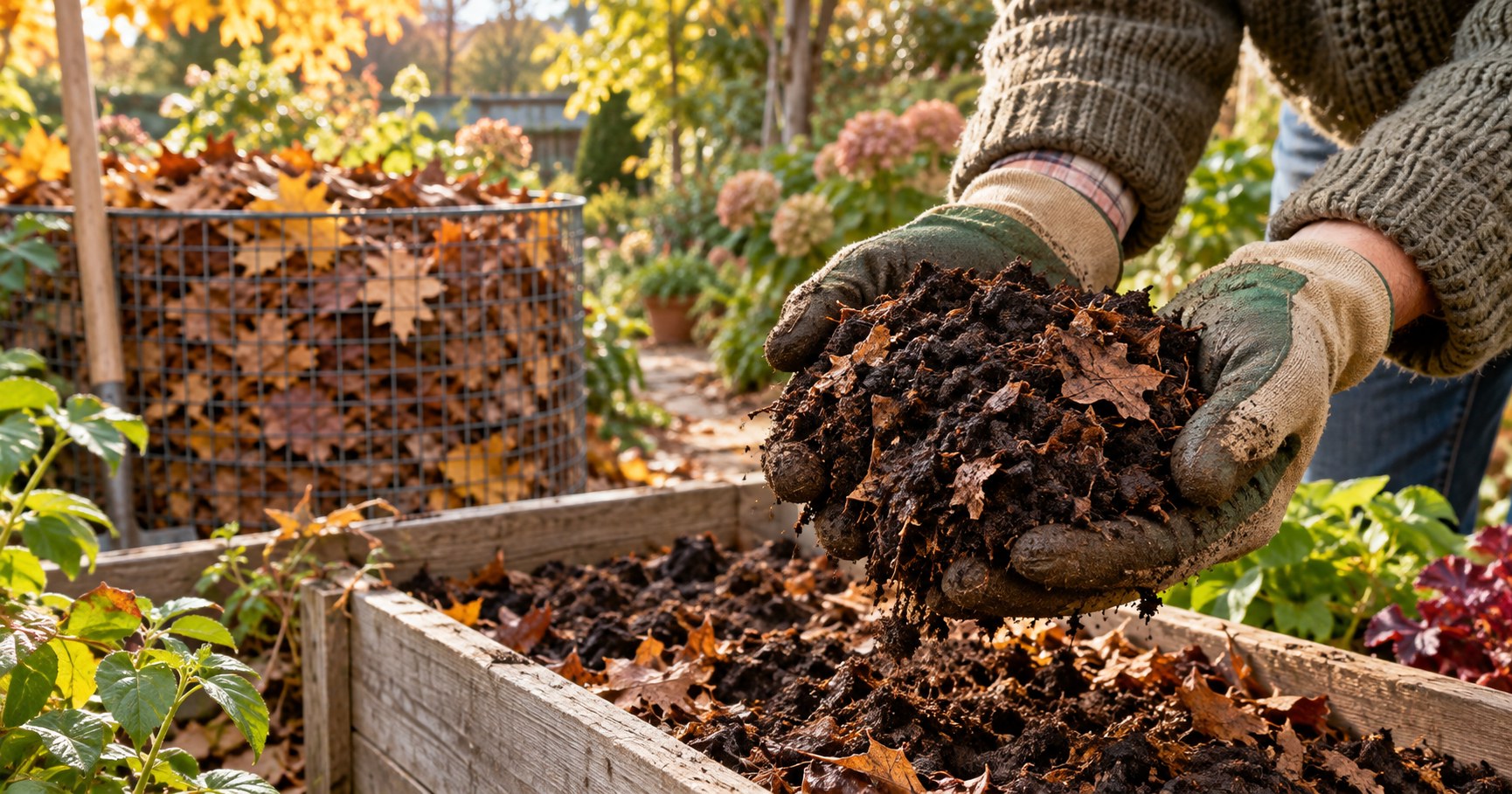
From fallen leaves to better soil: put October’s free resource to work
October brings a garden delivery you did not have to order: fallen leaves. Before sending every barrow away, give them a purpose. Soil cover, leafmould and an undisturbed corner offer three practical destinations with very little equipment.
Route 1: Cover bare soil
Loose leaves can cover empty beds or ground beneath woody plants. Spread them so they do not form a heavy, wet mat. Keep small plants and young salads uncovered, leave plant crowns clear and check the layer after rain or wind.
This is not a complete feeding programme. Fresh leaves do not replace an assessment of your soil or the nutrient needs of particular vegetables. Their immediate role is to cover the surface.
Route 2: Start a separate leafmould collection
Use a simple airy enclosure, such as a wire bin. Collect suitable fallen leaves, dampen dry material and allow air to reach it. Check moisture occasionally: avoid both bone-dry leaves and material sitting in water.
Leafmould develops gradually, largely through fungal decomposition. Depending on the leaves and conditions, it often takes one to two years. Shredding can speed the process; oak and other tough leaves may require more patience.
When the material is dark, crumbly and well broken down, use it as a soil conditioner. Coarser material is more suited to mulching. Judge the texture rather than assuming a particular anniversary makes it ready.
Route 3: Keep one corner quiet
Leave some leaves under a hedge or in a sheltered area that sees little foot traffic. Avoid disturbing this corner repeatedly. Clear wet leaves from paths where they can be slippery, and remove thick layers that block light from lawns. Different parts of the garden deserve different treatment.
Material to consider separately
The right treatment for visibly diseased leaves depends on the particular disease. Do not automatically return them to the affected bed. Leaves collected beside heavily polluted roads are not an obvious choice for food-growing areas either. Follow local disposal guidance when uncertain.
Your 30-minute plan
- Clear paths and heavily covered lawn patches.
- Spread suitable leaves over bare soil.
- Fill a small leafmould enclosure and dampen if needed.
- Leave one sheltered corner undisturbed.
- Record the location and starting date in the Permanatura garden planner.
Can leaves go into the ordinary compost heap? Small amounts, mixed with other materials, can. A separate leafmould collection is an easy alternative for a larger volume. Expect a useful soil conditioner rather than a quick batch of rich compost.
Reviewed 14 October 2026. Source and further reading: RHS: making and using leafmould.
Comments (0)
Sign in to comment.
📖 You might also like
Stop for one minute: how to read your autumn garden
Four small stations – light, herbs, path, wind – and one habit that helps you understand your garden better every year. Part 1 of the Autumn Journey.
Read more
One tree, many cycles: the sweet chestnut and permaculture
Fruit, leaves, soil and the story of the "bread tree": how one tree becomes a place of learning for families. Part 3 of the Autumn Journey.
Read more
Permaculture Zones According to Mollison: How to Plan Your Property Efficiently
The zone model according to Bill Mollison is the heart of every permaculture plan. Learn how to apply Zone 0 to 5 on your property - from the balcony to the large-scale farm.
Read more