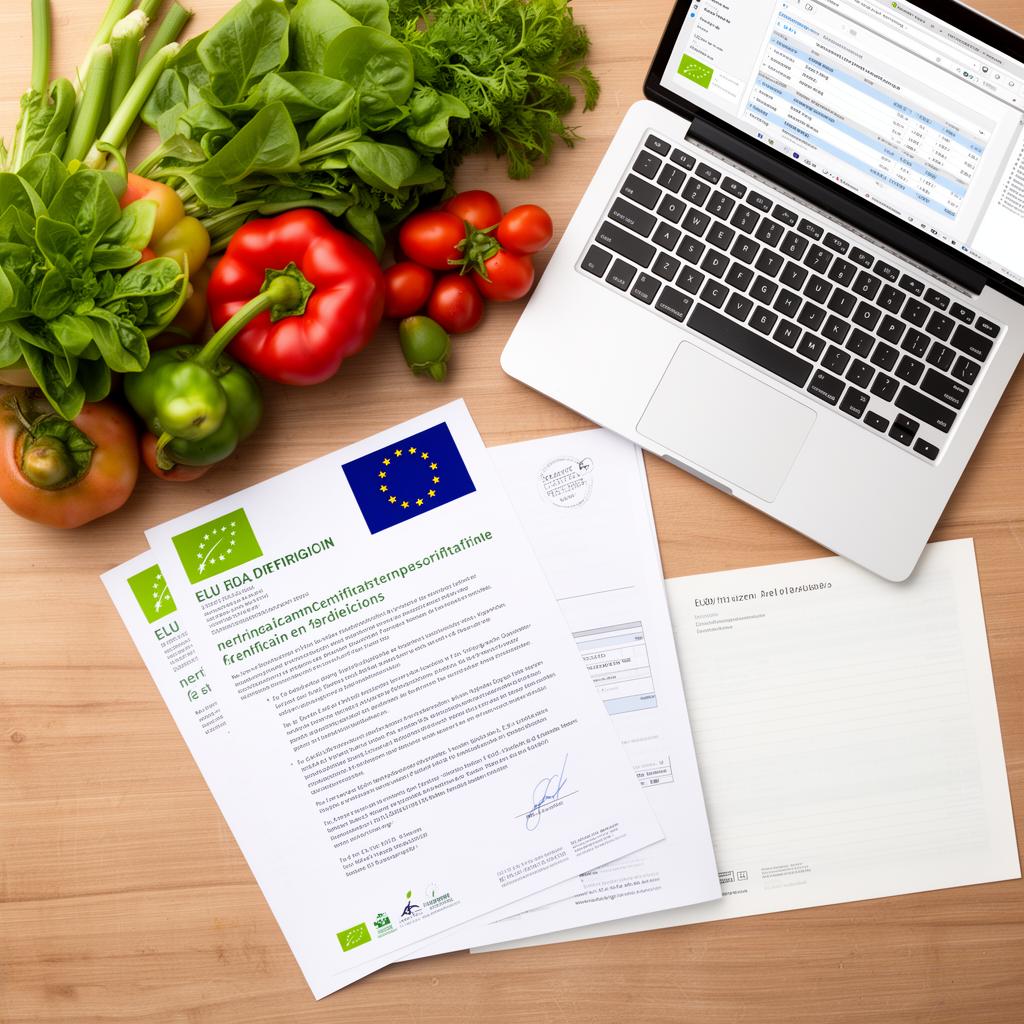
Regulation (EU) 2018/848: Documentation Without Paper Chaos
Regulation (EU) 2018/848 – Digital Documentation for Organic Farms
The EU Organic Regulation (Reg. 2018/848) has defined the binding standards for organic farming in Europe since 1 January 2022. For producers, processors and traders, this gives rise to extensive documentation obligations that can be considerably simplified by digital tools.
What does the regulation govern?
Regulation (EU) 2018/848 replaces the previous EC Organic Regulation 834/2007 and introduces significant innovations:
- Group certification for small producers (max. 2,000 ha/farm)
- Stricter import rules with a compliance requirement instead of equivalence
- Expanded product categories (salt, beeswax, essential oils)
- New requirements for seed and vegetative propagating material
The 7 core principles of organic production
| Principle | Description | Documentation requirement |
|---|---|---|
| Respect for biological systems | Promote a circular economy | Keep nutrient balances |
| Soil fertility | Prioritise humus build-up | Document soil analyses |
| Biodiversity | Preserve species diversity | Draw up a crop plan |
| Resource conservation | Use energy and water sparingly | Record consumption data |
| Species-appropriate animal husbandry | Enable natural behaviour | Keep husbandry records |
| Regional cycles | Feed preferably from the own farm | Purchase records |
| GMO-free | No use of GMOs | Supplier declarations |
Documentation obligations in detail
Field record (crop production)
Every organic farm must keep a complete field record:
- Crop sequence: Which crop on which field in which year
- Fertilisation: Type, quantity, timing and origin of all organic fertilisers
- Plant protection: Only approved products (Annex I of Reg. 2021/1165)
- Seed: Proof of origin, organic certificate or exemption
- Harvest quantities: Documented yields per field and crop
Flow-of-goods control
Traceability is a central element of organic certification. From the purchase of seed through sowing, care and harvest to storage and sale, every step must be documented.
💡 Practical tip: Keep a backup system in parallel with the digital documentation. During inspection visits, all documents must be available immediately.
Conversion period and deadlines
Conversion to organic requires different waiting periods depending on the use:
| Type of use | Conversion period | Marketing as |
|---|---|---|
| Arable crops | 24 months before sowing | Organic after conversion |
| Permanent grassland | 24 months before harvest | Organic after conversion |
| Permanent crops (fruit) | 36 months before harvest | Organic after conversion |
| Conversion goods | From 12 months | Conversion goods |
Digital documentation with PermaNatura
PermaNatura Profi supports organic farms in complying with the regulation:
- Automatic field record: All measures are recorded chronologically
- Organic compliance check: The products used are checked against the positive list
- Crop-rotation tracking: Crop sequences are documented over the years
- Export for control bodies: Data can be exported as PDF or CSV for the annual inspection
- Waiting-period calculator: Automatic calculation of the conversion deadlines
Common errors in organic documentation
- Missing purchase receipts for conventional seed (exemption!)
- Incomplete cleaning records in mixed farms
- No separation of goods flows documented
- Soil analyses older than 5 years
- Missing proof for organic fertilisers
💡 Important: In the event of violations, not only sanctions from the control body are at risk, but also the loss of organic certification for up to 2 years.
Conclusion
Regulation (EU) 2018/848 places high demands on documentation – digital tools such as PermaNatura make compliance considerably easier and significantly reduce the risk during inspections.
Comments (0)
Sign in to comment.
📖 You might also like
Digital Field Records: Why Excel Is No Longer Enough
From Excel lists to intelligent farm management: how a digital field record saves time, avoids errors and simplifies farm inspections.
Read more
GAEC Conditionality 2026: What Farms Need to Know Now
The GAEC standards for 2026 bring simplifications, but also new obligations. We show which requirements apply and how PermaNatura helps with implementation.
Read more
Demeter Certification: The Practical Guide for Biodynamic Farms
From horn manure to lunar calendar: what Demeter farms need to consider for certification and how digital documentation simplifies the process.
Read more